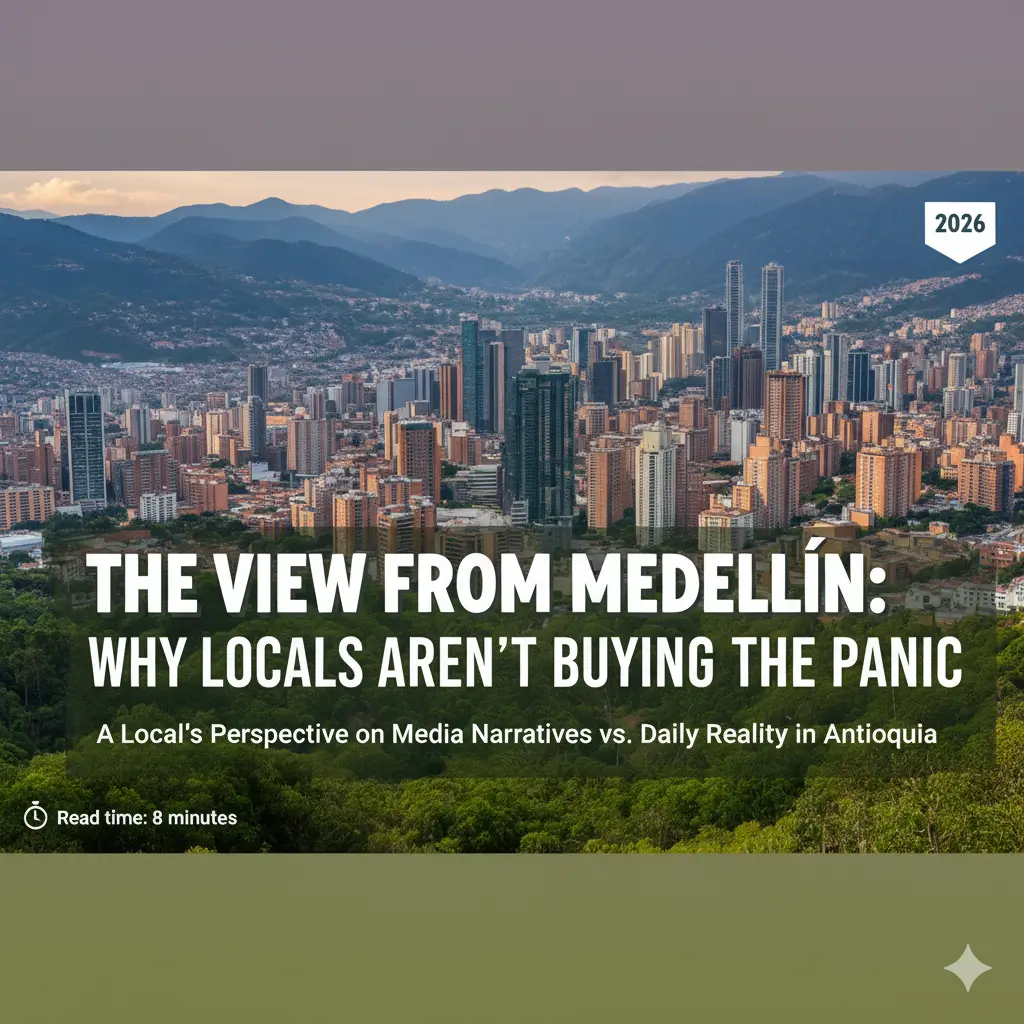
A Local’s Perspective on Media Narratives vs. Daily Reality in Antioquia
The gap between international headlines and street-level truth has rarely been more striking than in mid-January 2026. While news organizations thousands of miles away spin alarming stories about South America following recent developments in Venezuela, those of us living in Medellín and across the Antioquia region experience something entirely different: ordinary life, unfolding as it always has.
I’m writing this from a café in Laureles on Friday, January 16th. Around me, neighbors order their morning tinto, plan their weekend getaways, and browse their phones—not with anxiety, but with the casual indifference that comes from knowing sensational coverage seldom mirrors our actual circumstances. This reality rarely finds its way into global reporting.
The “Next Venezuela” Myth: Why It Doesn’t Hold Up Here
The anxiety spreading through expat forums and foreign press suggesting Colombia might somehow be “next” betrays a fundamental misreading of our nation’s past, its frameworks, and its present course. For those of us who call this place home, the parallel isn’t merely inaccurate—it borders on offensive to both countries’ unique situations.
Our Democratic Foundation
Colombia has sustained working democratic structures since the 19th century. We’ve faced our share of difficulties—no Colombian would dispute our complicated history with internal strife—but we’ve also shown remarkable institutional staying power. International bodies regularly monitor our elections, our Supreme Court functions autonomously, and peaceful leadership transitions have been standard practice, not anomalies.
Unlike the pattern that emerged in Venezuela over the last twenty years, Colombia’s system of checks and balances stays operational. Our press environment remains varied and frequently sharply critical of those in power. Our civic organizations speak out actively and loudly. Our commercial sector functions with reasonable certainty under established legal structures.
The Legal and Diplomatic Reality
President Gustavo Petro, regardless of your political stance toward him, isn’t confronting U.S. sanctions, international criminal charges, or the diplomatic ostracism that defined Venezuela’s leadership. Colombia continues as a crucial strategic ally for the United States and the wider international sphere, with partnership encompassing military cooperation, commerce, anti-drug initiatives, and regional steadiness.
The recent telephone conversation between President Petro and former President Trump on January 7th—characterized by both parties as “respectful and constructive”—reinforces this ongoing alliance. Trump’s stated willingness to welcome Petro at the White House doesn’t signal a relationship spiraling toward breakdown; it represents the continuation of decades-long strategic cooperation.
The Economy: Beyond the “Gringo Money” Misconception
Perhaps no assumption irritates locals more than the notion that Medellín’s economic energy stems chiefly from digital nomads and foreign pensioners. Venture into any barrio beyond Poblado or Laureles, and you’ll immediately grasp how ridiculous this idea truly is.
The Real Numbers
The expat community in Medellín accounts for less than 10% of the metro area’s nearly four million inhabitants. Throughout the broader Antioquia department, foreigners comprise well under 5% of the populace. Even in zones like El Poblado, which hosts the densest concentration of international dwellers, Colombians vastly dominate the demographic picture.
Who’s Really Spending?
When you observe the thriving restaurants in Envigado, the shopping centers crowded on weekends in Sabaneta, or the fresh commercial projects in Rionegro, you’re witnessing the buying power of Colombia’s middle class—not an influx of overseas capital.
That family sharing a meal beside you at a fashionable spot in Manila? Probably from Medellín, savoring their Sunday tradition after visiting extended family. The couple selecting furniture at Home Center in Las Vegas? Likely outfitting their recently purchased apartment financed through Colombia’s solid mortgage infrastructure. The professionals enjoying after-work cocktails in Provenza? Colombian engineers, business owners, marketers, and tech specialists who form the foundation of our expanding economy.
Structural Economic Transformation
The economic progress Antioquia has achieved over the last quarter-century isn’t happenstance or a temporary phenomenon—it’s the outcome of intentional investment in infrastructure, education, innovation, and pro-business policies enacted by consecutive local administrations.
Medellín’s evolution from one of the planet’s most violent cities in the early 1990s to a recognized center for innovation and enterprise stands as one of the most extraordinary urban reversals in Latin American memory. This didn’t happen because of vacation rentals or language academies—it happened through massive public investment in metro networks, cable cars linking informal settlements to economic prospects, library parks in underserved areas, and a cultural pivot toward social urbanism and inclusive growth.
The Ruta N innovation hub, the flourishing startup scene, the proliferation of universities and vocational programs, the expansion of sophisticated manufacturing in the Aburrá Valley—these represent Colombian accomplishments driven by Colombian ambition and resources.
What January Actually Looks Like in Antioquia
Let me sketch a picture of what’s genuinely unfolding here as we settle into the new year.
The Rhythm of Daily Life
The parks overflow with activity. Families still take advantage of the holiday period to explore the towns encircling Medellín—Guatapé, Jardín, Santa Fe de Antioquia. The restaurants hum with energy, not with anxious residents stockpiling necessities, but with people marking birthdays, anniversaries, and the simple joy of excellent food shared with those they love.
In my neighborhood, the corner shop owner just completed renovating his establishment. My neighbor maps out her daughter’s quinceañera for March. The construction team continues work on the apartment tower down the block. These aren’t the choices of people who anticipate imminent disaster—they’re the commitments of people assured about their tomorrow.
Business as Usual (Literally)
I recently chatted with a friend who runs a small manufacturing operation in Itagüí. He’s bringing on three new team members this month and just secured a contract with a client in Bogotá. Another colleague who manages a digital marketing firm is relocating to larger office space because her staff has multiplied.
Do economic headwinds exist? Certainly. Inflation impacts us as it does people everywhere. The peso’s value against other currencies shifts. But these constitute normal economic variables, not signs of systemic breakdown. Colombian enterprises adjust, negotiate, and keep operating because that’s what resilient markets do.
The Social Fabric Remains Strong
Perhaps most revealing is what you don’t witness: panic purchasing, capital exodus among local companies, or affluent Colombians liquidating holdings to relocate elsewhere. The social tapestry that makes Antioquia distinctive—the priority placed on family, community, and paisa identity—endures as vibrant as ever.
Attend any Sunday market, any neighborhood soccer match, any civic gathering, and you’ll encounter the same pattern: people engaged in their lives here, in their neighborhoods, and in their prospects within Colombia.
Regional Context: Understanding Where We Actually Stand
To grasp Colombia’s current standing, you need to step back and recognize where we fit in the wider Latin American panorama.
Economic Indicators
Colombia’s economy, while navigating obstacles, remains fundamentally distinct from Venezuela’s path. We possess:
- A varied economy not reliant on a single export
- Ongoing foreign direct investment from numerous nations
- Operating banking and financial frameworks
- Private sector advancement across diverse industries
- Regional trading partnerships that continue broadening
Institutional Strength
Our structures aren’t merely surviving—they’re performing. Courts issue rulings against the government routinely. Congress operates with multiple parties and perspectives. Governors and mayors from various political backgrounds administer their territories. The military stays professional and answerable to civilian leadership.
This institutional variety and autonomy creates organic constraints on any single political group amassing excessive authority—a fundamental distinction from Venezuela’s institutional takeover.
Why the Outside Narrative Misses the Mark
So why do global media and concerned expats misread the situation so badly? Several elements contribute to this gap:
The Simplification Problem
International coverage tends to condense complex regions into digestible storylines. “Latin America in turmoil” packages more easily than “Some nations facing difficulties while others show resilience amid typical democratic friction.”
The Echo Chamber Effect
Expat circles, particularly digital ones, can spawn echo chambers where worry feeds upon itself. Someone raises a concerned question, others voice their apprehensions, and suddenly a story of looming catastrophe gains traction—despite contradicting everything occurring beyond the forum.
Distance from Daily Reality
When you’re not here witnessing routine existence—the school drop-offs, the grocery runs, the weekend arrangements—it’s simpler to accept dramatic coverage. Proximity offers perspective that’s unattainable from afar.
Moving Forward: A Local’s Confidence
As we advance into 2026, those of us residing in Antioquia aren’t blind to obstacles. We recognize that Colombia grapples with inequality, rural advancement, and the continued implementation of peace agreements. We’re conscious that political division generates friction. We understand that worldwide economic pressures touch us too.
But we also grasp something distant watchers don’t: we’ve endured far worse and emerged more robust. The generation presently steering Medellín’s commercial community came of age during the bleakest days of the 1980s and 90s. They’ve witnessed their city transform through vision, commitment, and shared resolve.
The alarm and distress some observers project onto us simply doesn’t align with our lived reality or our comprehension of our own trajectory. We’re not dismissing challenges—we’re tackling them through the democratic structures and economic mechanisms that have served us progressively well over the past twenty-five years.
The Local Verdict: Life Goes On, With Confidence
As I finish composing this, I’m observing families meandering through the park opposite my café. Someone just launched a new juice bar on the corner—their grand opening sign advertises a 20% discount this week. The metro glides past precisely on time. A cluster of university students at the adjacent table debates their thesis subjects with the fervor only scholarly disputes can inspire.
This is the Medellín, the Antioquia, that escapes international coverage. This is the truth of millions of Colombians who rise each morning, head to work, develop their ventures, contribute to their neighborhoods, and chart their futures—not with blind optimism that overlooks difficulties, but with grounded confidence in their own resilience and their institutions’ durability.
The headlines might compress all of Latin America into a singular narrative of instability, but our lived reality tells a vastly different tale. There’s no strain in the atmosphere, no disruption to civic life, no alarm in the streets.
As we say here in Antioquia, “la felicidad es una decisión”—happiness is a choice. We’re choosing to live wholly, invest in our tomorrows, strengthen our communities, and trust in the frameworks and social fabric that have sustained us through far more challenging periods than these.
To those monitoring nervously from elsewhere: we value your concern, but we’re doing perfectly well. Come visit, enjoy a café con leche, and witness for yourself. The ground-level truth is nearly always more layered, more steady, and more promising than the headlines imply.
Frequently Asked Questions
Is it safe to visit Medellín right now in 2026?
Absolutely. Daily existence in Medellín proceeds normally despite international coverage about regional tensions. The city’s tourism apparatus operates fully, eateries and attractions welcome visitors, and locals go about their standard activities. As with any major metropolitan area, practice typical precautions, but there’s no exceptional safety worry connected to recent developments regarding Venezuela.
How much of Medellín’s economy actually depends on expats and digital nomads?
Less than 10% of Medellín’s metropolitan populace is foreign, and throughout the wider Antioquia region it’s below 5%. The commercial activity you witness—packed restaurants, fresh developments, retail districts—is chiefly fueled by the local Colombian middle class, not overseas funds. Medellín’s transformation across 25 years stems from structural economic advancement, public expenditure, and local enterprise.
Should I be worried about my investments or property in Colombia?
Local Colombians persist in acquiring property, growing businesses, and making sustained financial pledges. Unlike Venezuela’s course, Colombia sustains independent structures, a diversified economy, working financial mechanisms, and robust international alliances. While all investments entail risk and economic hurdles exist, there’s no widespread capital departure or distress among local investors who comprehend the ground situation.
What’s the actual relationship between Colombia and the United States?
Colombia remains a vital strategic partner of the United States with coordination spanning military matters, commerce, and regional equilibrium. The recent phone conversation between President Petro and former President Trump was characterized as “respectful and constructive,” with Trump voicing interest in receiving Petro at the White House. This stands fundamentally apart from the U.S. relationship with Venezuela, where sanctions and diplomatic separation have been typical.
Are Colombians leaving the country in large numbers?
No. There’s no mass departure of Colombians fleeing the nation. In fact, daily circumstances reveal the contrary: businesses are recruiting, families are organizing celebrations, construction advances on new projects, and people are making commitments that reveal confidence in their future here. The social fabric stays intact with emphasis on family, community, and local pride.
How is Colombia different from Venezuela institutionally?
Colombia has preserved working democratic structures since the 19th century with consistent elections, peaceful leadership changes, an independent court system, varied press landscape, and vigorous civic organizations. Unlike Venezuela’s institutional seizure over the last two decades, Colombia’s checks and balances stay functional. President Petro isn’t facing international penalties or criminal accusations, and works within a framework of institutional limitations.
What do locals actually think about the international media coverage?
Most locals find the “Colombia is next” storyline exasperating because it disregards our distinct past, structures, and present circumstances. When global media condenses all of Latin America into a single crisis narrative, it overlooks the nuance of what’s genuinely transpiring on the ground. The disconnect between worrying headlines and our everyday experience of ordinary life is substantial.
Is now a bad time to plan a trip to Colombia?
Quite the reverse. Colombia’s tourism infrastructure is superb, the peso’s exchange value can be advantageous for international travelers, and there’s no interruption to travel services. If you’ve been contemplating visiting Medellín, Cartagena, the Coffee Region, or other destinations, present conditions don’t pose any Venezuela-related barriers. Many locals would suggest this is actually an ideal moment to visit and observe the reality firsthand.
